Do I Have Relationship OCD, or Am I Just in the Wrong Relationship?
Now this is the million-dollar question that keeps you up until 2 am in a spiral, and here's the thing… I'm not so sure you're going to like my answer. This article isn't meant to give you a magical answer, pill, solution, or the ultimate form of certainty. It's meant to give you the facts while we sit with the discomfort that comes with the question: "what if?"
I remember my brain at the height of my OCD spiral. I did not know who to trust when I couldn't trust myself. I grew up my whole life being able to trust my gut and my intuition, but what happens when your "gut" is screaming, “get out of this relationship!”, when your brain and heart don't align with it? For me, the answer was Relationship OCD. OCD explained so many things about my life, so many questions left unanswered after 23 years of therapy. I searched and searched for certainty in my relationship and realized eventually that I would never find any.
The reason? No relationship out there has certainty. There is no 100% guarantee that your relationship will or won't work out. I stopped searching for certainty, and the spiral loosened its grip. What I chose to do with my relationship came after that, not before. Accepting that was the first step in healing for my brain.
If you're here because you want me to tell you whether this is ROCD or proof that your relationship is wrong, I get why you want that answer. I can't give it to you. More importantly, a blog post shouldn't make that call for you. What this article CAN do is give you some facts on ROCD and how it presents, and if you do the work with a therapist, hey, maybe just maybe you can get back in the driver's seat of your brain rather than OCD being the one at the wheel. I was in the passenger seat for 23 years, and let me tell you, it was a bumpy ride!
The part that gets mistaken for clarity
Relationship Obsessive Compulsive Disorder, or ROCD, is one tricky jerk, and an absolute pro at getting you to engage in its cycle. The OCD cycle is simple in theory, but in practice, it can keep you ruminating for hours searching for an answer that doesn't exist.
Dr. Guy Doron describes two main subtypes of ROCD: Type I, Relationship-Centered, and Type II, Partner-Focused. Feelings of not deserving your partner, or of being the problem, can show up within the broader ROCD picture, but I'd be careful about calling that its own third type. People can bounce between types from time to time (it has definitely happened for me!). In my opinion, the ultimate goal of the ROCD cycle is to gain certainty. (ICBT approaches this differently, and I can only speak to what it was like from the inside.)
The OCD cycle can be simplified into four parts:
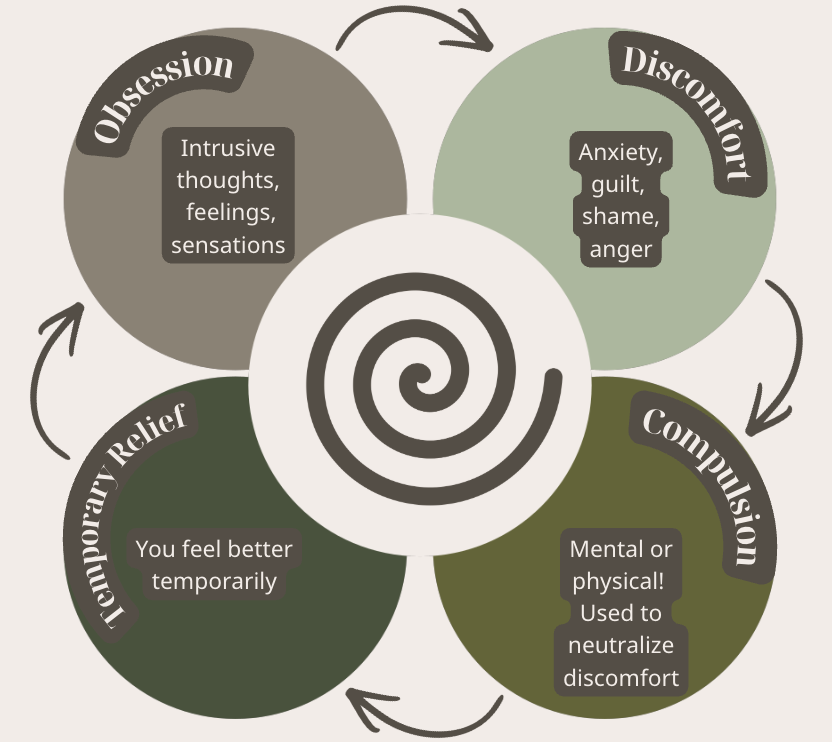
My version of the OCD Cycle
Obsession, Discomfort, Compulsion, Temporary Relief
Now, let's apply it to the ROCD brain!
Obsession: "What if I don't love my partner?"
Discomfort: anxiety, shame, fear
Compulsion: ruminating for hours on end about all the instances you knew FOR A FACT you loved your partner, asking Dr. Google or arguing with ChatGPT about the fact that you DEFINITELY love your partner… or how do you know? Either way, this goes on and on until…
Temporary relief: ah… finally, something clicks and there's the burst, the exhale, of your brain shutting off. (Spoiler alert: this doesn't last long. And if you're an OCD-having pro like me, you might get a little high off that burst of relief, because it's addictive!)
And for a minute, checking might work. You find a memory that feels right. You feel close again. Then a new thought arrives: "But what if I only felt close because I forced it?" Back to the beginning. On, and on, and on we go! This is why compulsive attempts to resolve the doubt can keep the cycle going.
But Lexi… what if the doubt is real?
That's the scary part, isn't it? Relationships can have real problems. There is no such thing as the perfect relationship, and no guarantee that even the healthiest relationships stand the test of time (your OCD hated hearing that, didn't it? Yeah, I've been there).
Here's the thing: people make decisions to stay or leave their relationships all the time! Some people get the ick and decide that's enough for them to call it off. However, that's not why you're here, is it? You're here because you've played out all of the scenarios. The ones where you stay, and the ones where you leave, and all of them terrify you. What if I told you that you didn't have to figure it out right now? What if I told you that you can have doubt in your relationship and CHOOSE to stay? You can have NO doubt in your relationship and CHOOSE to leave.
There are people who have true value differences in their relationship and still have the strongest relationship you've seen. There are also people who have every single thing in common and decide they're not right for each other. All of these facts exist, and yet your OCD is STILL looking for certainty. It's brutal, I know.
A thought can feel important without needing an emergency hearing in your brain. "What if this means I don't love them?" is a question. The spiral turns it into a deadline or a pass/fail test. OCD will tell you: Answer now. Answer perfectly. Answer in a way that will never change.
I don't know any relationship that can pass that test.
One caveat I always make: if you are in true danger in your relationship, if there is repeated abuse or maltreatment of any kind, that is worth taking seriously and exploring support and options for getting to safety. That is not something we should dismiss as ROCD. You deserve a life of safety, happiness and being valued.
What "don't answer it" actually means
I remember clear as day the most helpful thing my best friend (Hi Mel!) ever said to me: "Lexi, you do not have to make a decision to stay or go right now. You can give that decision to me to hold on the shelf for you until you're ready to address it."
That conversation with Melody helped me realize I did not have to answer the question right then and there. Instead, I CHOSE to work through my ROCD with a professional, really learn how my brain functions, and educate myself. Turns out, that was the best thing I ever did.
I never answered whether or not it was the "right" relationship, because I don't really believe the "right" relationship exists. I think many good relationships take work and come out the other end stronger. I know there will be times in my relationship where everything feels like bliss, and times where it will be tested. OCD wants a definite answer, but that doesn't exist, because that's not the way life works.
Instead of "answering it," we can name it. We can sit with the discomfort of having the thought, and then keep living according to our values instead of what OCD wants us to do.
This might sound like, "I'm having the urge to figure this out right now." Not "This is definitely OCD, so I'm safe." See the difference? One names what is happening. The other tries to sneak a final answer through the back door.
If you have OCD, working with an OCD-trained therapist can help you sort out compulsions and treatment without outsourcing your actual life choices to a stranger online. And if there are concrete issues in your relationship, those deserve room too. Both can be true. There is no quiz here that tells you which thought gets a stamp of approval. ERP is a first-line, evidence-based treatment for OCD, and IOCDF and NOCD both have great resources. ACT and ICBT are other evidence-based approaches worth learning about.
A note from inside the spiral
I know how persuasive the need to know can feel. It says, "Just one more check, and then we'll be able to live." The bargain keeps changing. A new standard for certainty appears every time you meet the old one.
So I'm not going to finish this with "If you're asking, it's ROCD" or "the right relationship feels easy." Neither is true enough to hand to a person at 2 a.m. Instead: notice the loop. Notice what you do to get relief. You don't have to settle the whole future from inside one anxious moment.
The OCD Collective is about finding acceptance in the spiral, not making uncertainty disappear. Together, we can do hard things!
Please note: this is not therapy or a diagnosis and is for educational purposes only.
